
Amplify Your Leadership Voice
Join industry leaders sharing insights with millions worldwide
Join industry leaders sharing insights with millions worldwide
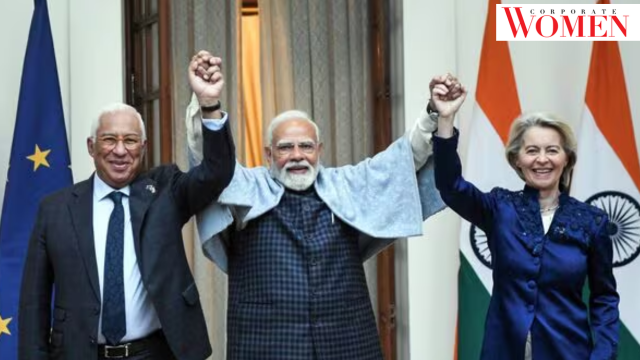
After close to two decades of negotiations, India and the European Union have concluded a landmark free trade agreement (FTA) that is being positioned as one of the most consequential trade pacts in recent global history. European Commission President Ursula von der Leyen described it as “the mother of all trade deals,” while Prime Minister Narendra Modi called it India’s largest and most ambitious FTA to date, underscoring its significance beyond mere tariff reductions.
Signed in the presence of European Council President Antonio Costa, the agreement brings together the world’s second- and fourth-largest economies, covering nearly 25% of global GDP and a consumer base approaching two billion people. Its scope spans agriculture, manufacturing, services, standards, and strategic cooperation—reflecting how trade policy has become inseparable from geopolitics.
Talks on an India–EU trade pact began in 2007, but negotiations stalled in 2016 due to sharp differences, particularly over agriculture, dairy access, and regulatory standards. For India, protecting small farmers and domestic food security was non-negotiable. For the EU, meaningful access to India’s tightly protected agri-food market was essential.
The global context changed dramatically after 2020. Supply chain shocks following COVID-19, the Russia–Ukraine war, and rising protectionism—especially new tariff pressures from the US—pushed both sides to reassess their strategic priorities. Talks resumed in 2022 and accelerated in 2025, culminating in an agreement that balances liberalisation with protection.
One of the most significant outcomes of the deal is India’s agreement to substantially cut import duties on European agri-food products, long considered among the highest in the world. Indian tariffs on these products currently average 36% and can reach 150%, effectively pricing many European goods out of the Indian market.
This is reflected in trade data: in 2024, EU agri-food exports to India were valued at just €1.3 billion, accounting for only 0.6% of the EU’s total agri-food exports. The agreement aims to unlock this potential while avoiding sudden shocks to India’s domestic agriculture.
The most visible—and politically sensitive—concessions are in alcoholic beverages:
These reductions reflect India’s willingness to open selective high-value segments while still controlling volumes and protecting domestic producers. For the EU, they represent long-sought access to a fast-growing, urban Indian consumer base.
The agreement extends well beyond wines and spirits. Import duties will be eliminated or sharply reduced on a wide range of products:
For Indian consumers, this expands choice and competition. For European exporters, it offers market access on terms the Commission has described as better than India’s FTAs with the UK and Australia.
Despite these openings, the agreement contains strong safeguards. The EU will retain tariffs on sensitive products including beef, sugar, rice, chicken meat, milk powder, honey, bananas, wheat, garlic, and ethanol. It will also introduce calibrated import quotas for items such as sheep and goat meat, grapes, cucumbers, dried onions, sweetcorn, and molasses-based rum.
A bilateral safeguard mechanism allows either side to respond quickly if imports rise sharply and threaten domestic markets, ensuring that liberalisation remains controlled rather than disruptive.
Addressing concerns around food safety, the European Commission has been explicit: “EU health is not negotiable.” All Indian products entering the EU must comply with its strict, science-based standards covering human, animal, and plant health.
The EU will retain full control over its food safety framework, conduct impact assessments on pesticide use and animal welfare, and strengthen audits and border checks where needed. This insistence on regulatory autonomy reflects a broader trend in modern trade agreements, where standards are as important as tariffs.
Alongside the FTA, India and the EU are negotiating a Geographical Indications (GI) agreement aimed at protecting traditional European food products from imitation in the Indian market. This is particularly significant for products whose value is closely tied to origin, heritage, and production methods.
The agreement also establishes an EU–India working group on wines and spirits, providing a formal platform for technical cooperation, information exchange, and smoother resolution of regulatory issues.
Both sides have been clear that this FTA is about more than economics. European Council President Costa has framed the partnership as one that contributes to global stability and resilience, while von der Leyen has argued that India’s growth strengthens global security.
For India, the deal supports key export sectors such as textiles, gems and jewellery, leather, steel, and manufacturing, while reinforcing its image as a reliable, long-term trading partner. For Europe, it secures access to one of the world’s most promising markets at a time when global trade patterns are being rewritten.
In substance and symbolism, the India–EU free trade agreement marks a turning point. It reflects the reality that trade policy today is deeply linked to geopolitics, supply chains, climate goals, and strategic autonomy.
As Prime Minister Modi noted, “This is not just a trade agreement—it is a blueprint for shared prosperity.” With carefully calibrated liberalisation, strong safeguards, and a broader strategic vision, the pact sets the stage for a new phase in India–Europe economic relations, one that could shape global trade dynamics for years to come.